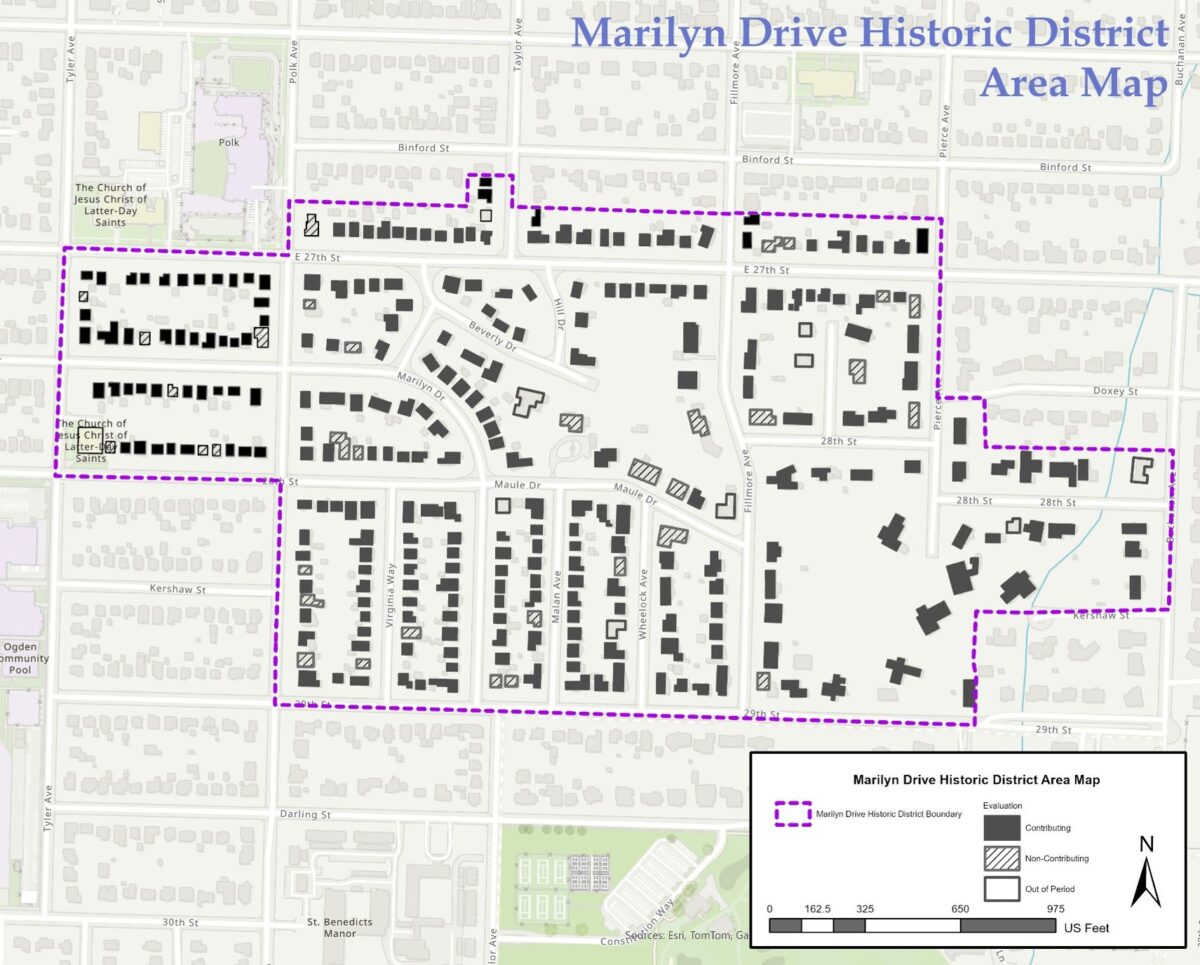
The Marilyn Drive Historic District, located on the east bench of Ogden, Weber County, Utah, includes 309 buildings, of which 265, or 86 percent, are contributing resources. The Marilyn Drive Historic District displays social, development and architectural influences which emerged in United States cities and early automobile suburbs during the first decades of the twentieth century and its historic and architectural resources are eligible within the “Historic Residential Suburbs in the United States, 1830-1960” Multiple Property Submission. The Marilyn Drive Historic District has local significance under Criterion A in the area of Social History, displaying the new patterns of residential development that emerged in the United States in response to changing social conditions and the introduction of the automobile. With Ogden’s strong rail-related economy and large population growth, conditions after 1920 were ripe for new affluent developments in areas that had been beyond the reach of most citizens before the widespread availability of affordable automobiles. The Oak Crest Park Addition subdivision and surrounding area, developed by Fred Froerer and J. Francis Fowles, was the first in Ogden to implement City Beautiful design principles and deed restrictions.
The Marilyn Drive Historic District has local significance under Criterion C in the area of Community Planning and Development, displaying important modern concepts in residential site development and neighborhood planning; for the distinction of its street design, integrating the natural landscape and built environment to create a neighborhood with remarkable parklike qualities and for its development, financing and construction by operative builders Fred Froerer and J. Francis Fowles. The Marilyn Drive Historic District has local significance under Criterion C in the area of Architecture for its variety of period revival and modern architecture examples. The period revival architecture introduced innovative construction techniques and materiality as well as innovative technology in its residential designs, many of which are the work of a master—the distinguished Ogden architect Arthur Shreeve, for which the district is also significant under Criterion C. Art Shreeve was the most distinguished architect in period revival styles in Ogden and second only to fellow Ogden architect Leslie Hodgson in prestigious commercial and educational commissions in the early decades of the twentieth century. With his partnership with Froerer and Fowles, Art Shreeve was probably responsible for the design and construction of the most residential buildings among the small group of distinguished architects in Ogden in the first half of the twentieth century and almost all of the period revival examples.
The Marilyn Drive Historic District period of significance begins in 1922 with the construction of the first contributing building in the district, the William B. and Victoria Passey residence at 1471 28th Street [photograph 45], and ends with the closure of the last Union Pacific railroad maintenance and support facilities in Ogden in 1970. The direct loss of railroad employment as well as industries dependent on rail transportation such as canning, stockyards and milling ended a century of prosperity and led to the flight of population, particularly affluent residents, from Ogden City. The economic malaise lasted into the 1990s when Ogden’s economy became more diversified and new permanent residents began to revitalize the city. Although most of the building lots within the district were already filled by 1970, the economic conditions paused the construction of similar high style residences in the immediate area until the 1990s.